
Vision and Mission
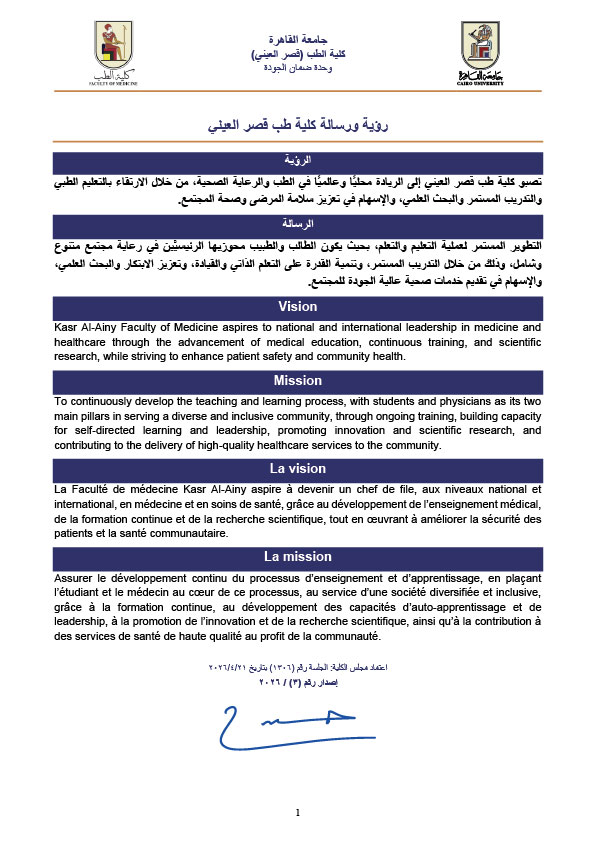
Policies of the Faculty of Medicine - Cairo University (Kasr Al-Ainy)

Strategic Goals and Objectives 2025–2030
The strategic goals and objectives of Kasr Al-Ainy Faculty of Medicine – Cairo University translate the Faculty's vision and mission, and are the outcome of an analysis of its internal and external environment (SWOT) conducted with the participation of stakeholders. They comprise eight strategic goals, under which forty-five strategic objectives are set, covering teaching and learning, scientific research and innovation, human resources, university hospitals, community responsibility, and local and international partnerships, in line with the standards of the National Authority for Quality Assurance and Accreditation of Education (NAQAAE) and Egypt Vision 2030.
- Improve the Faculty’s competitive position in light of international quality standards
- Achieve excellence in institutional performance, develop the Faculty’s self-generated resources, and strengthen professional responsibility in applying technology and artificial intelligence
- Develop students’ scientific and educational competence and build a distinguished student character
- Develop and enhance the skills and capabilities of human resources
- Develop the system of scientific research, innovation, and entrepreneurship
- Strengthen the Faculty’s role in achieving social responsibility and sustainable environmental development
- Develop the teaching hospitals in support of educational and training services
- Strengthen institutional cooperation and effective partnerships with various bodies and sectors locally, regionally, and internationally
- Improve the Faculty’s competitive position in light of international quality standards
1/1 Establish new, advanced bachelor’s programs in line with international standards
1/2 Establish joint postgraduate programs with peer faculties and universities, aligned with labor market needs
1/3 Establish professional training programs in subspecialties (e.g., professional diplomas)
1/4 Update the undergraduate and postgraduate academic bylaws in line with quality standards
1/5 Apply quality and accreditation standards to ensure that learning outcomes are aligned with labor market needs, renew institutional accreditation, and obtain programmatic accreditation
- Achieve excellence in institutional performance, develop the Faculty’s self-generated resources, and strengthen professional responsibility in applying technology and artificial intelligence
2/1 Develop the infrastructure and commit to regular maintenance
2/2 Improve the services provided to the Faculty’s staff
2/3 Support and activate the Faculty’s E-Learning Unit
2/4 Integrate artificial intelligence and its healthcare applications into educational and training curricula
2/5 Strengthen professional and ethical responsibility in the use of technology and artificial intelligence in medical education, scientific research, and healthcare
- Develop students’ scientific and educational competence and build a distinguished student character
3/1 Develop students’ creative skills and scientific thinking, and increase the number of students participating in scientific research
3/2 Develop academic advising and psychological counseling
3/3 Increase student participation in the Faculty’s official committees and councils
3/4 Support and develop student activities
3/5 Develop the internship training program
3/6 Develop the services of the International Students Office
- Develop and enhance the skills and capabilities of human resources
4/1 Raise the professional competence of faculty members and teaching assistants
4/2 Establish transparent criteria for evaluating the performance of faculty members and teaching assistants
4/3 Improve the performance efficiency of academic and administrative leaders
4/4 Ensure the sustainable development of administrative staff skills
4/5 Meet human resource needs in accordance with the approved job structure
- Develop the system of scientific research, innovation, and entrepreneurship
5/1 Update the scientific research plan and link it to national needs and the healthcare system
5/2 Increase financial and logistical support for research projects and scientific studies
5/3 Develop the Faculty’s scientific journals to achieve a high impact factor
5/4 Encourage and support researchers to raise citation rates
5/5 Support research projects with economic and national impact
5/6 Develop and support clinical research and link it to the university hospitals
5/7 Support innovation and entrepreneurship
5/8 Consolidate research integrity and ethics, and enhance the efficiency and transparency of research ethics review mechanisms and the handling of misconduct
- Strengthen the Faculty’s role in achieving social responsibility and sustainable environmental development
6/1 Develop the medical services provided to the community
6/2 Strengthen the Faculty’s role in community service and environmental development
6/3 Activate the Alumni Follow-up Office and complete the establishment of the Alumni Association
6/4 Prepare a plan to market the services of the special-nature units and increase their revenues
6/5 Strengthen the application of international occupational health and safety standards
6/6 Strengthen the application of international environmental management standards
6/7 Strengthen the application of international energy management standards and rationalize energy consumption
6/8 Coordinate with state agencies to contain epidemics and health risks
- Develop the teaching hospitals in support of educational and training services
7/1 Digitize the services of the university hospitals
7/2 Enhance the clinical and academic excellence of the university hospitals in education and training
7/3 Increase funding and develop the self-generated resources of the university hospitals
7/4 Obtain quality accreditation for a number of units and university hospitals in preparation for joining the Universal Health Insurance System
- Strengthen institutional cooperation and effective partnerships with various bodies and sectors locally, regionally, and internationally
8/1 Increase the number of scientific cooperation agreements with foreign universities
8/2 Encourage joint research with local, regional, and international bodies and institutions
8/3 Increase channels of communication, coordination, and cooperation with local health bodies and institutions
8/4 Increase joint supervision missions between the Faculty and international universities
Organizational Structure of the Faculty of Medicine - Cairo University (Kasr Al-Ainy)
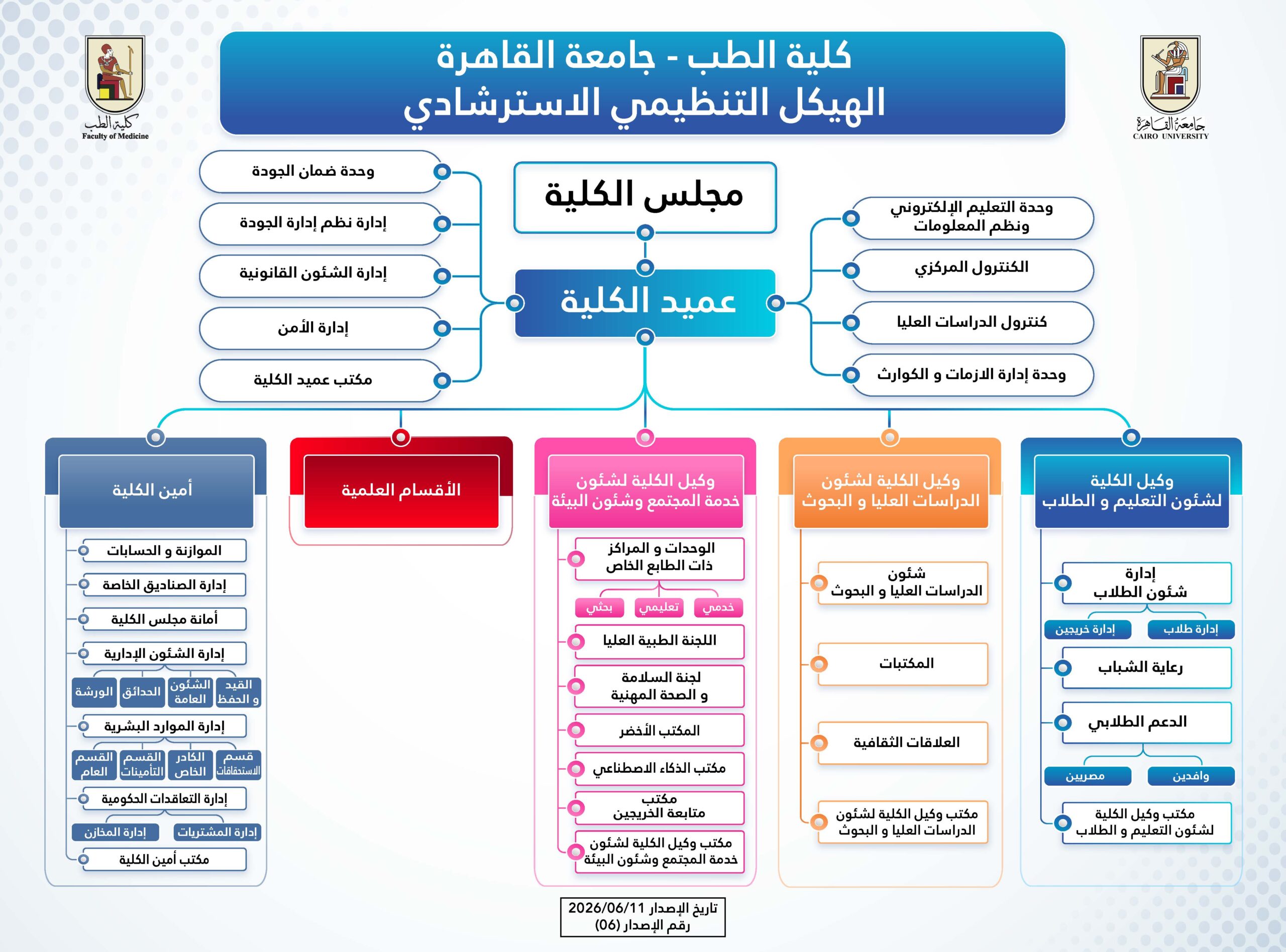
Organizational Structure of the Quality Assurance Unit

Human Resources of the Faculty
PG Students
Undergraduate Students
Medical Outreach Missions
Accreditation


